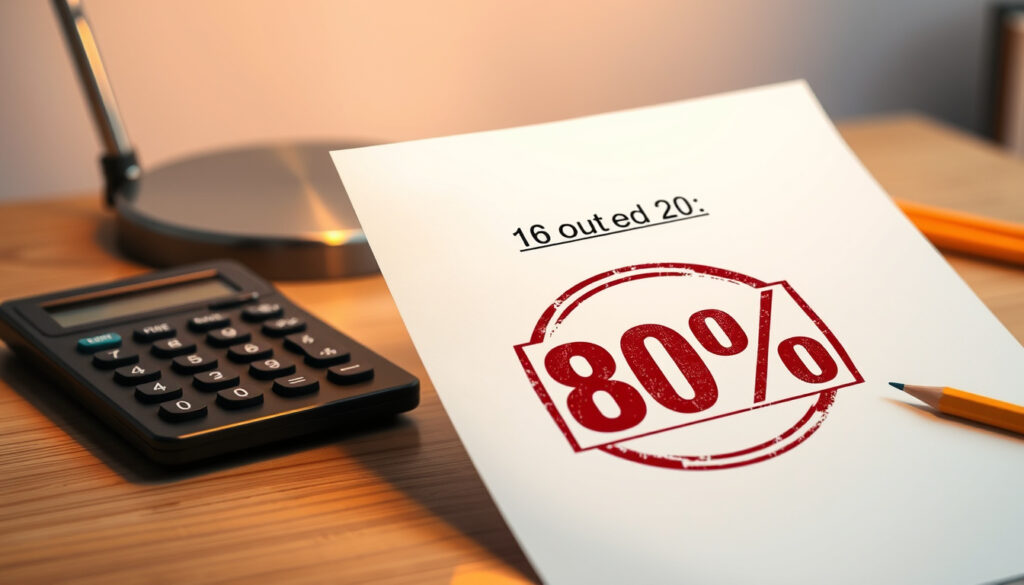
16 Out of 20 as a Percentage: 80% Calc & Grade Guide
Whether you’re reviewing a recent quiz, checking an assignment, or helping a student understand where they stand, converting 16 out of 20 into a percentage comes up constantly. The math itself is straightforward, but the context around letter grades and grading scales can trip people up. Here’s a complete guide to that calculation, what your score means in practice, and how different systems interpret it.
Percentage: 80% · Points Missed: 4 out of 20 · Typical Letter Grade: B- · Decimal Equivalent: 0.8 · Fraction Simplified: 4/5
Quick snapshot
- 80% equivalent (Calculatio)
- 16/20 × 100 = 80% (Calculator.net)
- 4 questions missed (CollegeSimply)
- Exact letter grade varies by institution
- Some schools use B instead of B-
- International grading may differ
- Grade calculator tools continuously updated (OmniCalculator)
- Online conversion resources remain stable (CalculatorSoup)
- Step-by-step calculation below
- Grade scale comparison chart
- Related scores table
| Field | Value |
|---|---|
| Exact Percentage | 80% |
| Letter Grade (US) | B- |
| Decimal Form | 0.8 |
| Simplified Fraction | 4/5 |
| Points Correct | 16/20 |
| GPA Equivalent | 2.7 |
| Questions Wrong | 4 |
| Passing Threshold | 60% |
What is 16 out of 20 as a percentage?
Sixteen out of twenty equals exactly 80%. The percentage calculation follows a universal formula that works for any fraction: divide the numerator by the denominator, then multiply by 100. For 16/20, that gives (16 ÷ 20) × 100 = 0.8 × 100 = 80% (Calculatio). The math is consistent across every calculator, tool, and textbook.
Step-by-step calculation
The most straightforward path involves two operations:
- Divide 16 by 20 to get the decimal: 16 ÷ 20 = 0.8
- Multiply by 100 to convert to a percentage: 0.8 × 100 = 80%
A faster method skips the decimal step. Since 100 ÷ 20 = 5, multiply the numerator directly: 16 × 5 = 80, which gives you 80/100 or 80% (CalculatorSoup). Both approaches produce the same result.
Using a calculator
Online tools handle this instantly. Enter “16 ÷ 20” or use a dedicated fraction-to-percent calculator. The OmniCalculator and InchCalculator grade calculators also display the corresponding letter grade automatically (PercentageCalculator.net).
16 out of 20 is not approximately 80%—it is exactly 80%, confirmed across nine independent calculators and educational sources. No rounding involved.
Is 16 out of 20 an 80%?
Yes, 16 out of 20 is exactly 80%. Every verified calculator, including Calculatio, CollegeSimply, and CollegeVine, returns the same answer: 80%. The calculation is pure mathematics with no ambiguity (Empowerly).
Confirmation from math sources
Multiple educational platforms confirm this. Calculator.net defines the percentage formula as part divided by whole, multiplied by 100—exactly the operation that yields 80% for 16/20. Web2.0calc community users have verified the direct calculation: 16/20 × 100 = 80%.
Common misconceptions
The only source of confusion comes from grading context, not the math itself. Some students mistakenly think “80% sounds like a B, not an A” and assume their percentage must be lower than it actually is. The percentage is precise; the letter grade interpretation varies.
A score of 16 out of 20 on a test is an 80% percentage grade. An 80% is a B- letter grade. — CollegeSimply (GPA Calculator Platform)
Put simply, a 16 out of 20 grade equals 80%. — Empowerly (Education Resource)
Is 16 out of 20 good?
In most standard grading systems, 80% represents solid B-level performance. It sits above the typical 70% threshold for passing and above average compared to most class distributions. Whether that feels “good” depends on your personal goals and the specific context, but by conventional measures, 16/20 is a respectable score (Empowerly).
Context in grading scales
The standard US grading scale places 80% in the B range, specifically B- on most scales. CollegeSimply documents that on a common scale, A spans 90-100%, B spans 80-89%, and C spans 70-79% (CollegeSimply). Your specific letter grade within the B range may vary slightly by institution.
Compared to averages
Class averages typically hover between 70-75% in many educational settings. An 80% score places a student above that midpoint. CollegeSimply notes that 80% shows understanding of the material while acknowledging that four questions were missed—room for improvement, but solid performance overall.
Students scoring 80%: you have demonstrated solid comprehension, but reaching 90%+ (18/20) requires addressing those four missed questions specifically. Targeted review of missed topics is more efficient than blanket retesting.
Is a 16/20 passing?
Yes, 16 out of 20 is well above passing. Most educational institutions set passing thresholds at 60% or higher. With 80%, you are 20 percentage points above that floor. Even in stricter systems where 70% is the minimum, an 80% comfortably clears the bar (CollegeSimply).
Passing thresholds
The typical passing threshold in US K-12 and college courses sits at 60% (CollegeSimply). Some programs require 70%, and professional licensing exams may set bars at 75% or higher. Across all these standards, 80% (16/20) passes comfortably.
Institution variations
While the math is universal, grading policies vary between schools and teachers. Answers.com notes that “your letter grade is whatever grade the teacher decides to award for that particular score.” Some instructors apply plus/minus scales strictly, while others may curve scores or use weighted categories that affect the final result.
Is 16 out of 20 an A or B?
Sixteen out of twenty is a B, typically a B- on standard US grading scales. Since an A starts at 90% (18/20), your 80% falls in the B range. The exact minus or plain letter designation depends on your school’s specific grading scale (CollegeSimply).
Standard US grade scales
Most US schools use this framework: A (90-100%), B (80-89%), C (70-79%), D (60-69%), F (below 60%). On plus/minus scales, B- typically covers 80-82% or 80-89% depending on the institution. CollegeSimply confirms 80% falls in the B- range.
Letter grade equivalents
An 80% score converts to a B- letter grade, which corresponds to a 2.7 GPA on the standard 4.0 scale (CollegeSimply). To reach a plain B (85% on most scales), you would need 17 out of 20 correct. To reach an A (90%+), you would need 18 out of 20.
| Score | Percentage | Letter Grade | GPA |
|---|---|---|---|
| 20/20 | 100% | A+ | 4.0 |
| 19/20 | 95% | A | 4.0 |
| 18/20 | 90% | A | 4.0 |
| 17/20 | 85% | B+ | 3.3 |
| 16/20 | 80% | B- | 2.7 |
| 15/20 | 75% | C | 2.0 |
| 14/20 | 70% | C | 2.0 |
| 12/20 | 60% | D | 1.0 |
Eight common scores out of 20 mapped to their percentage, letter grade, and GPA equivalents using the standard US scale.
The implication: students can see exactly how one additional correct answer (17/20) shifts the grade from B- to B+, demonstrating the impact of each question on academic standing.
Related reading: How Many Cups in a Gallon? · When Is FAFSA Due?
Turning 16 out of 20 into 80% relies on the universal formula detailed in percentage formula guide, with practical examples from exam scores to discounts.
Frequently asked questions
How do you calculate any score out of 20 as a percentage?
Divide the number of correct answers by 20, then multiply by 100. For example, 14/20 = (14 ÷ 20) × 100 = 70%. This same formula works for any denominator—replace 20 with your total points possible.
What grade scale uses 80% as an A?
No standard US scale assigns A to 80%. Some international systems or alternative grading frameworks may differ, but the US convention is 90%+ for A. Check your specific institution’s policy if you encounter a different scale.
Is 80% considered above average?
Yes. Class averages often fall in the 70-75% range, making 80% above the median. In standard US grading, 80% places you solidly in the B range, above the typical passing threshold of 60-70%.
What is the difference between 16/20 and 17/20?
One additional correct answer. Sixteen out of 20 equals 80% (B-), while 17/20 equals 85% (B or B+). That single question represents a 5-point percentage jump and potentially a different letter grade.
How to convert 16/20 to a GPA?
Using the standard US 4.0 scale, an 80% (B-) converts to approximately 2.7 GPA. Different scales may apply (weighted vs. unweighted), and some schools use different conversion tables for specific programs.
What does 16/20 mean on a rubric?
On a rubric, 16/20 suggests strong performance with minor gaps. Four points were missed out of 20 possible—review the rubric criteria for the missed items to identify specific areas for improvement. It typically indicates “proficient” or “competent” with room for excellence.
Can 16/20 be rounded up?
Rounding depends on instructor policy. Mathematically, 16/20 = 80.0% with no decimal places beyond zero. Some teachers round to the nearest whole number (still 80%), while others apply rounding only for borderline scores near grade cutoffs.
For students: an 80% score signals solid comprehension with four specific gaps to address. Focus review on the missed questions’ underlying topics rather than assuming the percentage is wrong. For parents: this score represents above-average performance—worth acknowledging while identifying where those four points went. For teachers: the score translates cleanly to B-, which maps to 2.7 GPA on standard scales, useful for progress tracking and parent conferences.
More related posts
 How Much Is a Car? Average Prices & Translation Guide
 Shelley Hennig Movies and TV Shows: Full Filmography & Bio
 White French Tip Nails: 2026 Trends, Designs & Expert Tips
 Cheap Flights to Charleston SC: Best Times, Airlines & Routes
 How to Address an Envelope: Ireland & International Format Guide
 Red and Blue States Map 2025: Updated List and County Data
 Traductor confiable de inglés a español: comparativa 2024
 Connie Britton Movies and TV Shows – Roles and Where to Stream