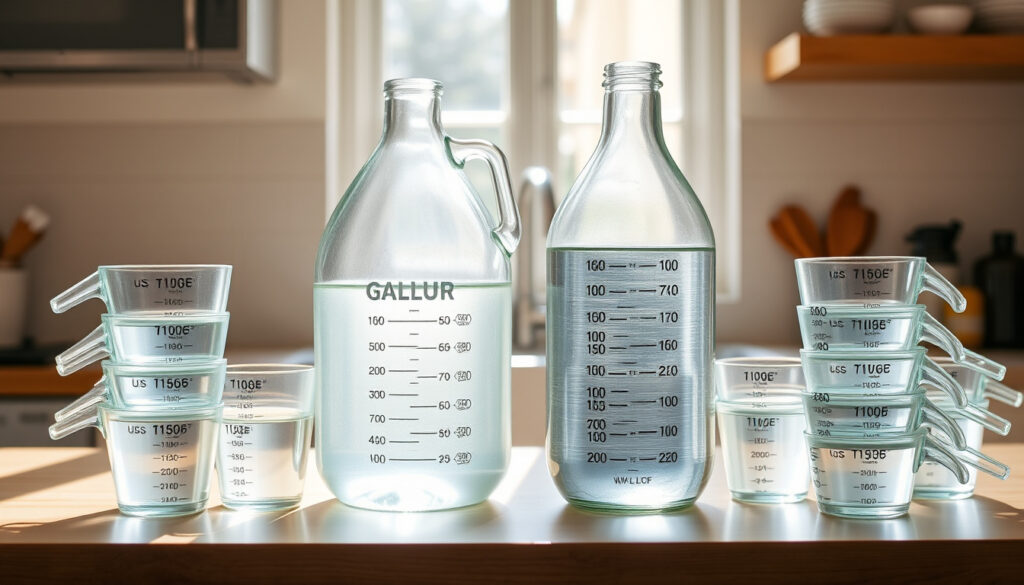
How Many Cups in a Gallon? US & UK Guide
You’re mid-recipe when you notice it calls for a gallon of milk. Your measuring cup sits nearby, and you pause: exactly how many cups are in a gallon, anyway? It’s a deceptively loaded question—because the answer depends on which gallon you mean. A US liquid gallon holds 16 cups (Safecastle), but a UK gallon contains about 19.2 US cups (Conversion Unites), and even within the US system, dry goods use a different gallon entirely. This guide sorts out every version so your next kitchen conversion lands correctly.
US Liquid Gallon: 16 cups · US Dry Gallon: 18.62 cups · Half Gallon (US Liquid): 8 cups · Pint (US): 2 cups · UK Gallon: 16 UK cups (≈19.2 US cups)
Quick snapshot
- US liquid gallon = 16 cups (Safecastle)
- US dry gallon = 18.618 cups (Metric Conversions)
- US liquid gallon = 128 fluid ounces (NFC Academy)
- Dry gallon rarely used in modern home cooking
- Standard recipes assume liquid gallon conversions
- Exact cup counts for flour/sugar vary by packing method
- US customary system formalized in the 19th century (Parade)
- UK imperial gallon defined in 1824 (Unit Converters)
- Metric transitions reduced dry gallon use in 20th century (Parade)
- Comparison table for all three gallon types
- Step-by-step conversion for each recipe scenario
- FAQ covering kitchen-specific conversions
The US customary system divides volume measurements into cups, pints, quarts, and gallons, with each unit doubling as you move up the ladder.
| Unit | Cups | Pints | Quarts |
|---|---|---|---|
| 1 Cup | 1 | ½ | ¼ |
| 1 Pint | 2 | 1 | ½ |
| 1 Quart | 4 | 2 | 1 |
| 1 Gallon (US liquid) | 16 | 8 | 4 |
How many cups is 1 gallon?
The short answer for most kitchen work is 16 cups in a US liquid gallon (Safecastle). This holds true whether you’re measuring water, milk, oil, or broth. One US liquid gallon breaks down to 4 quarts, 8 pints, and 128 fluid ounces, with each unit doubling as you move up the ladder (Parade).
Liquid vs dry gallons
The US system maintains separate gallon definitions for liquids and dry goods. The US dry gallon equals 18.61832 cups (Metric Conversions)—notably larger than the liquid gallon. This difference traces to the historical purpose: dry gallons originally measured agricultural products like grains and produce, where compactness and weight matter more than container shape.
- US liquid gallon: 16 US cups, 3.7854 liters, 128 fluid ounces (NFC Academy)
- US dry gallon: 18.618 US cups, 4.40488 liters, 148.9 fluid ounces (Metric Conversions)
US standard
For recipe conversions in the United States, always assume the liquid gallon (16 cups) unless your source specifically mentions dry goods or agriculture. Most home cooks will never encounter the dry gallon in practice—it’s a unit more at home in farming commerce than in kitchens (Golf Ventures).
What this means: if you’re following an American recipe and it calls for a gallon of anything liquid, you need 16 standard US measuring cups. The math is simple: multiply gallons by 16, and you have your cup count (Omni Calculator).
Does 4 cups equal 1 gallon?
No—4 cups equals exactly one-quarter of a US liquid gallon. If your recipe asks for a gallon and you measure only 4 cups, you’ll have just 25% of what the recipe requires. This is one of the most common conversion errors in home baking, where impatient measuring leads to dry or under-flavored results.
4 cups to gallons fraction
- 4 cups = ¼ gallon (0.25 gallon)
- 8 cups = ½ gallon (0.5 gallon)
- 12 cups = ¾ gallon (0.75 gallon)
- 16 cups = 1 full gallon (1 gallon)
Common misconception
The confusion often arises from misremembering the relationship. Some assume gallon-to-cup conversions follow a simpler 4:1 ratio (four cups per gallon), but that’s actually the quart-to-cup ratio: 1 quart equals 4 cups. A gallon, being 4 quarts, naturally equals 16 cups (Parade).
The catch: the math shortcuts we remember often mix measurement systems. If you think “four cups is a lot—surely that’s close to a gallon,” you may be anchoring on quart-level quantities rather than gallon-level ones.
Is it 16 cups to a gallon?
Yes, the US liquid gallon consistently equals 16 cups (Safecastle). This conversion is so standard that Omni Calculator cites it as the foundational multiplier: “One US gallon is equivalent to sixteen cups” (Omni Calculator). The math is exact, not approximate.
US confirmation
The US liquid gallon-to-cup conversion traces to formal measurement charts maintained by educational institutions. NFC Academy’s official chart confirms: 1 gallon = 128 fluid ounces, and since 1 cup = 8 fluid ounces, division yields exactly 16 cups per gallon (NFC Academy PDF). The arithmetic is verifiable and consistent across any credible US measurement source.
Exceptions
The 16-cup rule applies exclusively to US liquid gallons. Two important exceptions exist:
- US dry gallon: 18.618 cups—encountered when measuring dry goods by volume in agricultural contexts
- UK imperial gallon: 19.2 US cups—because the UK gallon itself is larger (defined at 4.54609 liters vs US 3.7854 liters) (Conversion Unites)
Recipe conversions often assume liquid gallons (16 cups), which works perfectly for liquids but can introduce errors when adapting UK or specialty recipes (Bake It With Love).
Does 8 cups equal 1/2 gallon?
Yes, exactly. Eight cups equals one-half US liquid gallon. This is one of the more intuitive conversions since the half-gallon is a common retail size (particularly for milk in the US). If you buy a half-gallon of milk at the store, you’re bringing home 8 cups of liquid.
Half gallon breakdown
- Half gallon (US liquid): 8 cups, 64 fluid ounces, 4 pints, 2 quarts
- Half gallon (UK imperial): 8 UK cups, approximately 9.6 US cups
Practical use
The half-gallon serves as a useful mental checkpoint for kitchen work. Rather than calculating 16 cups from scratch, you can halve it twice: gallon → half → quarter. This makes scaling recipes easier when you need ½ or ¼ gallon quantities. For reference: 1 cup = 8 fluid ounces (Parade), so 8 cups × 8 ounces = 64 ounces, which is exactly half of 128 ounces in a full gallon.
Home cooks following UK recipes without accounting for the larger imperial gallon will consistently under-measure liquids by roughly 17%, producing recipes that are noticeably too thick or dry.
How many cups are in a pint?
One US liquid pint contains exactly 2 cups (Parade). This is the building block that makes the gallon math work: since a gallon contains 8 pints, and each pint holds 2 cups, 8 × 2 = 16 cups per gallon.
Pint to cups
The pint-to-cup relationship scales cleanly upward. Whether you’re measuring berries, soup stock, or ice cream, the math holds:
- 1 pint = 2 cups
- 2 pints = 4 cups (1 quart)
- 4 pints = 8 cups (½ gallon)
- 8 pints = 16 cups (1 full gallon)
Build to gallon
Understanding pints gives you a practical intermediate step for gallon conversions. When a recipe calls for a gallon and you only have pint measurements, simply multiply pints by 2. Eight pints equal one gallon—easy to remember, and useful when halving or doubling recipes that specify quantities in pints.
What this means: if you’re working from a recipe that measures ingredients in pints, you can mentally convert to cups at a 2:1 ratio and then apply the 16-cup-per-gallon standard without touching a calculator.
How US, UK, and dry gallons compare
Three different gallons exist in practical use today, and conflating them leads to measurement errors. The comparison below clarifies exactly how they differ in cup volume.
The implication: “gallon” alone tells you nothing—you must know which system before you can calculate.
| Gallon type | Cups (same system) | Liters | Fluid ounces |
|---|---|---|---|
| US Liquid | 16 US cups | 3.7854 | 128 |
| US Dry | 18.618 US cups | 4.40488 | 148.9 |
| UK Imperial | 16 UK cups (≈19.2 US cups) | 4.54609 | 153.7 |
The pattern is clear: “gallon” is not a universal volume. The US liquid gallon is the smallest of the three at 3.7854 liters. The US dry gallon sits larger at 4.40488 liters. The UK imperial gallon is largest at 4.54609 liters (Metric Conversions).
Cooks who ignore the UK-to-US gallon difference risk producing results that are noticeably off—a UK recipe measured with US cups will yield about 80% of the intended quantity.
Related reading: 2025 Toyota Grand Highlander Hybrid – Specs, Price, MPG & Trims · How Much Do Braces Cost – 2024 Averages, Types and Insurance
Baking enthusiasts know precision counts, as the US and imperial conversions guide outlines alongside our charts for half-gallon and pint breakdowns.
Frequently asked questions
How many cups in a gallon of water?
A US liquid gallon of water equals 16 US cups (128 fluid ounces). Since water has a near-1:1 density with other water-based liquids, this conversion applies equally to broths, juices, and milk.
How many cups in a gallon of milk?
A gallon of milk contains 16 US cups, identical to water. The fat content in milk does not significantly alter volume at typical temperatures for home cooking.
How many cups in a gallon UK?
A UK imperial gallon equals 16 UK cups. In US cup measurements, this translates to approximately 19.2 US cups due to the larger UK gallon volume (Conversion Unites). Using US cups to measure a UK recipe means you’ll need fewer total cups to reach one gallon.
How many cups in a gallon of flour?
Using the US dry gallon, approximately 18.618 cups of flour fit in a gallon by volume. However, flour compresses differently depending on how it’s scooped and sifted, making weight measurements (pounds or kilograms) more reliable for baking precision.
How many quarts in a gallon?
One US liquid gallon contains exactly 4 quarts (Parade). This relationship is consistent for both liquid and dry measures in the US customary system.
What is the relationship between pints, quarts, and gallons?
The hierarchy is consistent: 1 gallon = 4 quarts = 8 pints = 16 cups. Each step down halves the previous quantity. This predictable doubling pattern makes scaling recipes straightforward (Golf Ventures).
How many cups in a gallon of sugar?
By volume using the US dry gallon, approximately 18.618 cups of granulated sugar fit in a gallon. As with flour, weight-based measurements offer greater accuracy for baking, where sugar density affects recipe outcomes significantly.
Key facts
The measurement landscape becomes clearer once you separate the three gallon types and understand their cup equivalents.
Confirmed facts
- US liquid gallon = 16 cups
- Pint = 2 cups
- Quart = 4 cups
- Gallon = 4 quarts
- US liquid gallon = 128 fluid ounces
- 1 cup = 8 fluid ounces
What remains unclear
- Exact cup count for flour/sugar varies by packing method
- Dry gallon rarely used in modern home kitchens
- UK-to-US recipe adaptation may require judgment calls
What the measurements tell us
Parade Food (a food-focused publication) puts it plainly: “There are 16 cups in a liquid gallon; a dry gallon equals 18.6 cups” (Parade). The Metric Conversions site adds crucial context: “The US dry gallon is different from the US liquid gallon, which is used for measuring liquids and is slightly smaller in volume” (Metric Conversions). Together, these sources confirm that the question “how many cups in a gallon?” requires knowing WHICH gallon before any math begins.
There are 16 cups in a liquid gallon; a dry gallon equals 18.6 cups.
— Parade Food (Food Publication)
One US gallon is equivalent to sixteen cups.
— Omni Calculator (Conversion Tool)
More related posts
 How Old Is Rod Stewart? Age, Wives, Children & Health
 Happy Work Anniversary Images: 50+ Best Sources, Funny GIFs, and Free Downloads
 Joe Rogan Net Worth 2025: $200M-$250M from Spotify
 Truck Accident Lawyer Near: Ireland Injury Claim Guide
 Cavaliers vs Wizards: Player Stats & Game Recap 2026
 Camping World Near Me: Ireland, UK Dealers & Rules
 Lamb Chops Near Me: Dublin Stores, Prices, Cuts & Health Tips
 Cast of Zero Day TV Series – Full List of Actors & Roles