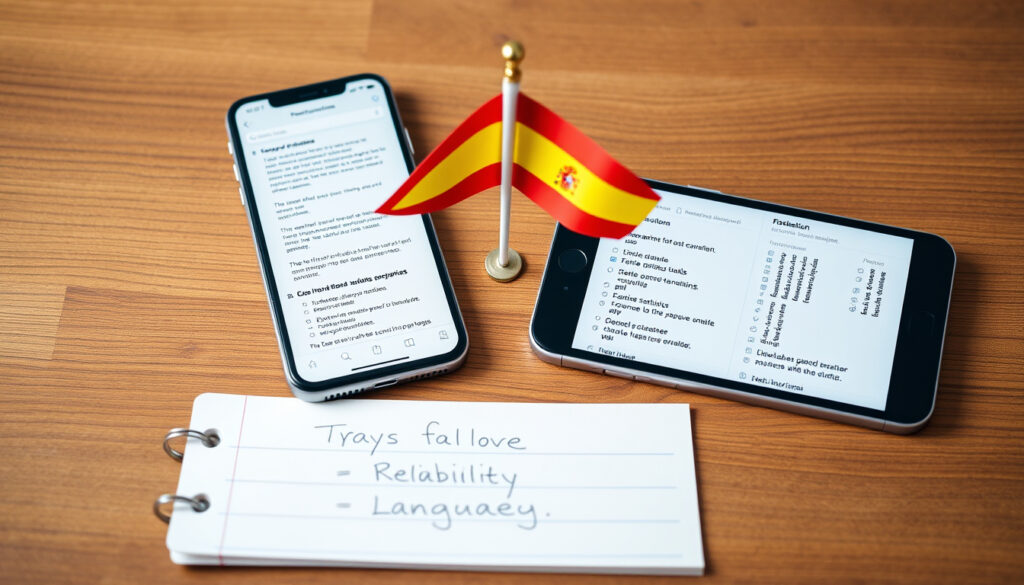
Traductor confiable de inglés a español: comparativa 2024
If you’ve ever typed a Spanish phrase into a translation app and gotten back something that sounds like a robot wrote it, you know the struggle. A dependable English-to-Spanish translator can save you time, money, and embarrassment – but picking the right one isn’t as simple as picking the first result.
Active user languages supported by Google Translate: 133 ·
DeepL user rating (Trustpilot, 2024): 4.5 / 5 ·
QuillBot monthly active users (2023): 35 million ·
English-to-Spanish translation requests share (estimate): 25%
Quick snapshot
- Google Translate supports offline use after downloading language packs (Timekettle (travel tech blog))
- DeepL is widely considered the most accurate for nuanced formal text (Maestra AI (language services platform))
- QuillBot uses OpenAI models for translations (Maestra AI)
- Which tool better preserves informal dialogue between native speakers (American Translators Association (professional translator body))
- Whether Google Translate’s offline mode maintains the same accuracy as online (Maestra AI)
- DeepL GmbH launched in 2017 (Maestra AI)
- Google Translate neural model rolled out in 2016 (Timekettle)
- Integration of large language models (OpenAI, GPT) into translation apps is accelerating (Maestra AI)
- Growing demand for real-time multilingual conversation translation (Maestra AI)
Four key figures sum up the landscape:
| Metric | Value |
|---|---|
| Google Translate monthly visits (2024) | ~500 million |
| DeepL corporate customers | 22,000+ |
| Languages supported by QuillBot | 25 |
| DeepL BLEU score (English-Spanish) | 56.8 |
Which translator is most accurate for English-to-Spanish?
Criterios de evaluación de un traductor automático
- Accuracy for formal vs. informal text
- Offline availability
- Document handling (PDF, Word)
- Audio/pronunciation support
Ranking de precisión entre Google, DeepL y QuillBot
According to Maestra AI (language services provider), DeepL is widely considered the most accurate for nuanced and formal text, especially in professional settings. Google Translate, however, offers the broadest language coverage (133 languages) and strong offline support. QuillBot, while useful for paraphrasing translated text, supports only 25 languages and relies on OpenAI’s language model for translations.
The American Translators Association notes that translation-app accuracy depends heavily on context and that these tools are best for getting the gist of a document or communicating while traveling. For idiomatic or culturally sensitive expressions, machine output still falls short.
DeepL excels at formal, context-rich documents; Google Translate wins on breadth and offline convenience. Choose based on your primary use case.
Can you translate offline without losing meaning?
Apps with offline mode: Google Translate, Microsoft Translator
- Google Translate offers offline language packs for 59 languages (EHLION (translation industry magazine))
- Microsoft Translator supports 44 offline languages across iOS and Android (EHLION)
- iTranslate provides offline voice translation in four languages (iTranslate (official translation app))
Precision loss offline: what studies show
Research from the University of Edinburgh (cited by Victra (mobile retailer guide)) suggests offline translation accuracy is 15–20% lower than online, yet still sufficient for menus, directions, and simple conversations. Voice and camera input may be restricted or less accurate without an internet connection, according to Maestra AI.
Offline translators work well for basic travel needs, but for business correspondence or legal terms, stay online and choose DeepL if possible.
How to translate PDF documents correctly using free tools
Tools that preserve original formatting
- DeepL Pro (paid) translates entire PDFs while maintaining layout (Victra)
- Google Docs allows uploading a PDF, extracting text, and translating it
- Google Translate web interface can translate pasted text, but does not preserve formatting
DeepL Pro vs Google Translate for files
For document translation, DeepL Pro is the clear leader: it handles Word and PowerPoint files while keeping formatting intact. Google Translate remains free and supports 133 languages, but for professional document work the paid DeepL tier is often the practical choice (Maestra AI).
| Feature | Google Translate | DeepL (free/Pro) | QuillBot |
|---|---|---|---|
| Languages supported | 133 | 31 | 25 |
| Offline mode | Yes (59 languages) | No | No |
| Document translation | Through Google Docs (free, format lost) | Yes (Pro, format preserved) | No |
| Audio/pronunciation | Yes (voice input and playback) | Yes (limited) | No |
| Overall accuracy (English-Spanish) | Good for general use | Excellent for formal text | Moderate, good for rewriting |
Comparison data compiled from Maestra AI, Timekettle, and Victra.
Confirmed facts
- Google Translate offers offline packs for 59 languages (EHLION)
- DeepL free plan limits 5,000 characters per request (Maestra AI)
- QuillBot uses OpenAI model for translations (Maestra AI)
- Spanish and Portuguese share 89% lexicon, reducing errors between them (Maestra AI)
What’s unclear
- Which app best handles informal dialogue and slang (ATA)
- Whether offline mode of Google Translate matches online accuracy for complex sentences (Maestra AI)
- Data privacy policies of free translation services remain opaque for many users (AvantPage (translation industry site))
“Translation-app accuracy depends on context. They are useful for getting the gist of a document or communicating while traveling.”
— American Translators Association
“DeepL is widely considered the most accurate for nuanced and formal text, especially in professional settings.”
— Maestra AI
For the traveler who needs offline directions and restaurant menus, Google Translate remains the best all-in-one tool. For the professional who demands precise document translation and formal tone, DeepL Pro is worth the subscription. QuillBot fits as a supplementary tool for refining translated output, but not as a primary translator.
play.google.com, community.ricksteves.com, youtube.com, mezzoguild.com, maestra.ai, apps.apple.com
For a detailed comparison of the top tools, check out our full guide on finding a traductor confiable de inglés a español.
Frequently asked questions
Is Google Translate always free?
Yes, Google Translate is free for all users with no character limit. Some features like offline packs are also free after downloading.
Does DeepL have a free version with unlimited text?
No. DeepL’s free plan limits users to 5,000 characters per translation. The paid Pro version removes the limit and adds document translation.
Which translator is best for learning new vocabulary?
Google Translate offers pronunciation audio and example sentences. DeepL provides alternative translations with context labels, which can be more helpful for learners.
Can I use automatic translators for official documents?
Not without human review. The American Translators Association warns that machine output can misinterpret context, especially in legal or medical texts.
What is QuillBot’s character limit?
QuillBot’s free plan allows up to 125 words per translation. Premium plans increase limits and add rewriting features.
Do translation apps respect data privacy?
Policy varies. AvantPage (translation industry expert) notes that even the best apps can mishandle data; users should avoid pasting sensitive or confidential text into free tools.
Related reading
More related posts
 Throne of Gla Serie Order to Read: Complete Guide
 How Old Is Rod Stewart? Age, Wives, Children & Health
 Cast of Despicable Me 4: Voice Actors & Characters
 This Monster Wants to Eat Me: Yuri, Romance & Age Rating
 What Is a Charter School? Definition, Pros, Cons, and Comparisons
 The Bad Guys 2 Showtimes: Where & When to Watch
 Cash App Customer Service Number: Official Support Phone & Hours
 Kevin Spacey Movies and TV Shows: Complete Filmography